
Home Teams
An American in Spain on the beautiful game
I call it football now. It’s not a conscious decision. I’m not trying to be hip, or cheeky, or whatever. After twenty years in Spain, following the game in bars with Spaniards and Brits, that’s just the word that comes out. Football. The one you play with your feet.
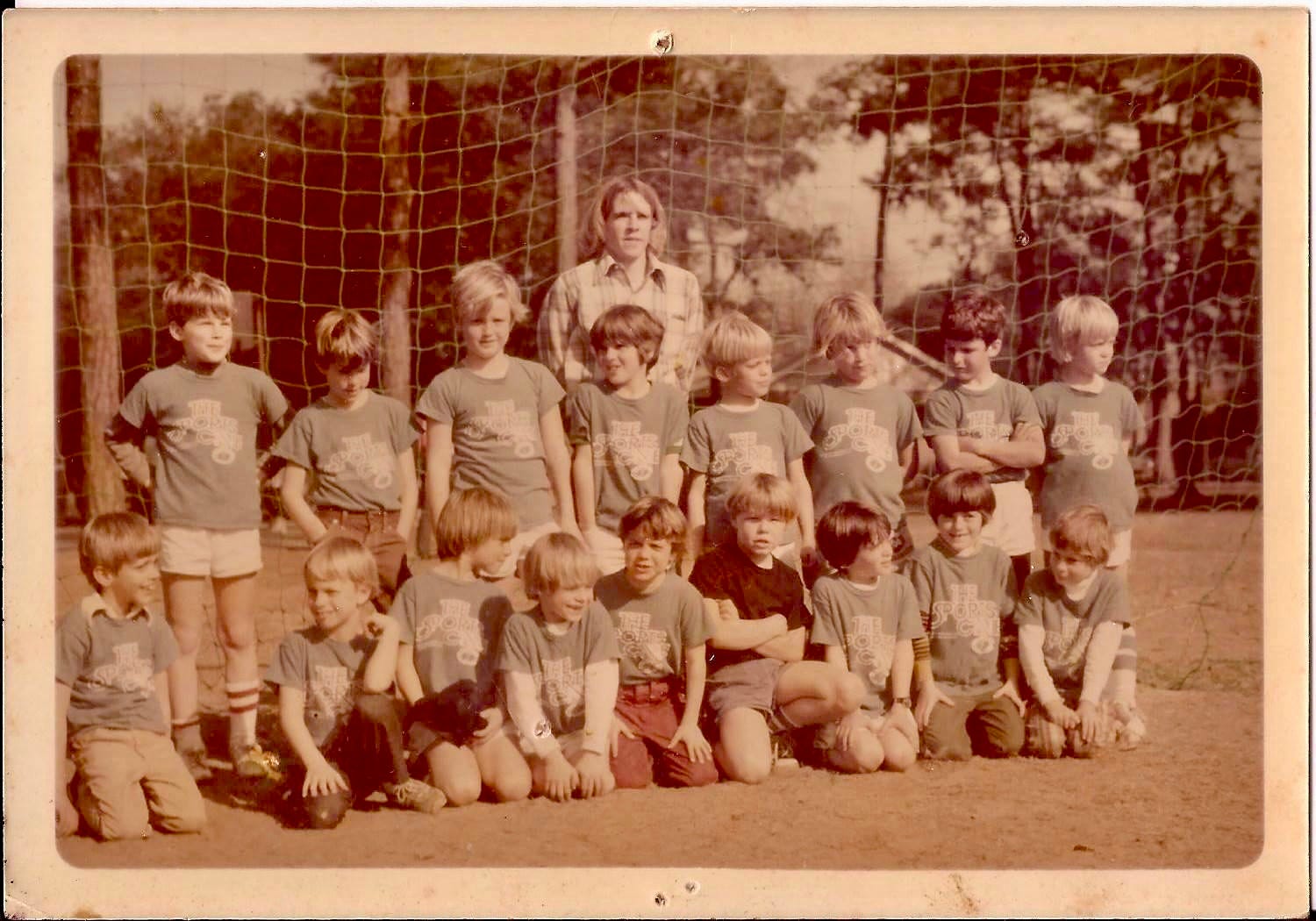
“Soccer” doesn’t feel quite right anymore. “Soccer” now sounds to me like it has probably always sounded to its doubters back in the States—like a lesser sport, not fully serious, maybe because the country that calls it that, my native country, has never taken it as seriously as I have. Growing up I had runs as a blue-ribbon swimmer, a fairly reliable first baseman, and a half-decent tennis player, but the beautiful game was the one that truly inspired me. It was the sport I stuck with, the only one to have ever honored me with a nickname. I had hair back then, a whole mess of it, and my specialty, the slide tackle, saw me rolling around on the ground a lot. Coach Fred Norchi called me “Tumbleweed.”
Spaniards are surprised to hear all this. They know the sport is growing in the States, and the US women’s team has been making international headlines for years, but I am a man of a certain age. ¿Fútbol? In South Carolina? In the seventies and eighties? Well, yes. On teams like the Cougars, the Cyclones, and the Gremlins, for school leagues in the fall and rec leagues in the spring, you could find us playing it. Where you couldn’t find people playing it, was on TV. Every so often a coach would show us some classic World Cup match on VHS, and we would sit transfixed. So that’s how it’s done.1
With cable television, access and interest grew, but soccer could never compete with baseball, basketball, or the football you play with your hands. In 2006, watching the World Cup at a friend’s house in Charleston, I mused that for the next one, we should take a trip to a country that cared. It didn’t have to be the host country, just some place where the bars, the living rooms, and the airwaves would be buzzing with the spirit of the competition. Some place where it mattered.
The next year, I moved to Spain. At that time I didn’t have a particular club team to pull for—what the hell was “La Liga,” anyway?—but I didn’t need one. Just seeing my sport being played by professionals on TV at the local bar on a Saturday afternoon…I cannot overstate how thrilling that was. In a weird way, it felt like coming home. I wasn’t long in adopting the Spanish national team, La Roja, as my own, eagerly and completely. You might call it the zeal of the converted, but then again, I’d never really needed converting to the game. I’d only needed a country that loved it as much as I did.
Three years later, not long after Concha and I were married in Jerez, Spain raised the World Cup, its first. I remember every detail of the winning goal, made as the clock ran out. Whatever sport you may have played growing up, Andrés Iniesta’s goal in the closing minutes of the 2010 World Cup is the kind of play you dreamed of: the final act of the championship, you have one chance to make history, and you do. When the ball hit the back of the net, the entire country exploded in jubilation. Spain, that notoriously fractured nation, limping through yet another economic crisis, had triumphed.2 Spaniards who cared nothing for the sport, Concha among them, rejoiced. So did I. While they celebrated the country they’d been born to, I celebrated the country I’d come to, and the sport that had managed, for a moment at least, to bring it together.
Today, again, Spain could use some bringing together. The whole world could.
Vamos.
Imagine being a basketball kid and never seeing Jordan play on TV. It’s hard to “be like Mike” if you don’t even know who Mike is.
German Chancellor Otto von Bismarck: “I am firmly convinced that Spain is the strongest country in the world. Century after century, trying to destroy herself and still no success.”