
Somewhat Holy Week
My first Semana Santa
In terms of significance and collective anticipation, Semana Santa in Spain recalls the Christmas holidays in the States, when those who have ventured off for school, work, and/or marriage return to their native pueblos to eat, drink and consort with family and childhood friends. The jasmine is blooming, the moon is full, spring has taken the stage: the time is right for throwing down with the old crew in the old-school way. Yet for all the plainly secular merry making, all the feasting and fraternizing, you don’t hear pundits clamoring to put the santa (“holy”) back in Semana Santa. They don’t have to. For a lot of people Holy Week is still, well, holy: daily masses, penitential processions, crucifixion scenes. The santa is there if you want it, and many do.
Over the centuries some towns have developed their own particular versions of Semana Santa. Puente Genil, the town I first moved to in 2007, has an especially distinctive one. While most towns are content to tell the story of the Passion and call it a week, Puente Genil stages the entire Biblical story, from Adam and Eve on down to Revelation, with a corresponding hermandad, or “brotherhood,” responsible for each Biblical allegory. The lead-up to Semana Santa finds the various brotherhoods gathering in their respective cuarteles, or headquarters, for planning sessions. Locally touted as “living museums,” each of the more than twenty cuarteles corresponds to a particular Biblical story or figure: Jonah and the Whale, the Head of John the Baptist, The Parables, etc. The oldest brotherhood, Los Fariseos (The Pharisees), is said to date back to the 17th century. The men I talked to were intensely proud of their respective hermandades, happily recounting the unabridged history from founding to present, eagerly showing off display cases full of retired costumes and props and aged membership photos that dated back to the earliest days of photography. Hailing from a country that sheds ritual like dead skin, I can’t deny I was captivated by all this. It was something to explore, soak up, maybe write about one day.
In the event, my first Semana Santa was a dizzying dance of the sacred and the secular. On any given day during the week, I had only to head down to one of the main streets around dusk, and shortly I’d be welcomed into a cuartel, a bar, or a courtyard for an endless parade of drinks and tapas served with song and cheer. I’d have thought the locals were trying to get the americano tipsy, for kicks, if they hadn’t been getting tipsy, too. We were putting the pagan back in Easter, if you like, as though Christianity had never stepped in and grafted its own renewal story onto the calendar. But then a procession would approach, and the mood would turn abruptly reverential. As a Virgin Mary inched past—several tons of gold, silver and wood ornamented with fresh-cut flowers and legions of candles, mounted on the backs of a dozen concealed men—hats would come off, hands would trace the sign of the cross, tears would well. Ay, qué bonito, sounded the hushed commentary. Mira, qué preciosa… Una maravilla…
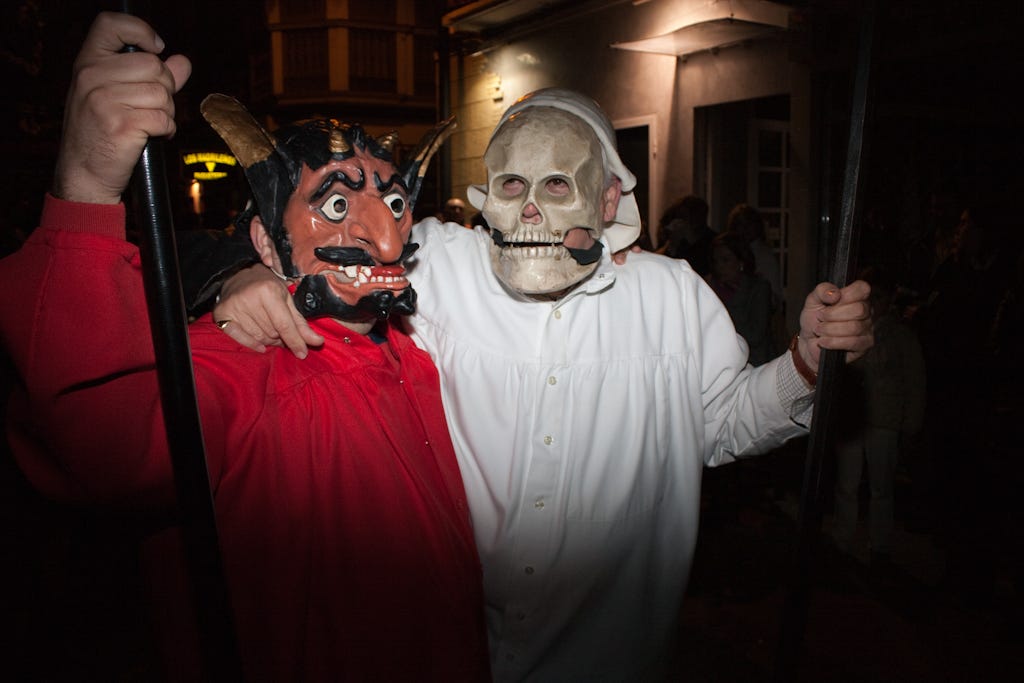
As for the legions of men in tall white hoods with eye cut-outs, white robes cinched loosely about their waists with rope…it was no use knowing that the Holy Week tradition pre-dated the Klan by centuries, that beneath the Klan’s ghostly get-up had stood a bunch of preposterous fools and ingrates: whenever I happened upon a group of hooded penitents on a dark side street, marching ponderously to the beat of a low, primeval-sounding drum, I would freeze up, as if hoping not to be noticed by them. Often they were accompanied by an astonishingly well-conceived el Diablo chained to an equally menacing la Muerte, but not even this grim pair, Satan and Death, could match the penitents for the unease they inspired, and it was always a bit of a relief to emerge back into a main thoroughfare, take my place among the cerveza-swilling merrymakers, the cotton candy stands and souvenir SpongeBob balloons.
If there is one tradition that engenders the peculiar brew of the festive and the pious that is Semana Santa in Puente Genil, it is Los Romanos. The Romans. During Semana Santa Los Romanos is the only brotherhood permitted to march spontaneously and at random, whenever and wherever they want, representing as they do the arrogance of the Roman Empire at the time of Christ. They are known to, in fact expected to, march against the carefully choreographed processions of the other brotherhoods—that is to say through them, in the contrary direction—quite suddenly, unannounced, like impetuous children seeking attention. Odd indeed is the sight of a funereal John the Baptist procession—headed by, well, the head of John the Baptist, carried on a plate—abruptly infiltrated by a phalanx of brightly festooned centurions marching in the opposite direction to a brassy tune. This looks like a gaffe, an embarrassing malfunction in the plan, but in fact it is all part of the plan, and insomuch as it counterpoises the celebratory and the solemn, it aptly captures the spirit of Semana Santa in contemporary Spain.